The Spec Sheet: Decoding AI Versions
Pro vs. Flash? Opus vs. Sonnet? GPT-4 vs. 5.2? Here is how to read the confusing version numbers of AI like a pro.

The Spec Sheet: Decoding AI Versions
Buying an AI subscription in 2026 feels a lot like buying a car. You walk onto the lot and see three different versions of the same model:
- The "LE" (Economy)
- The "XLE" (Standard)
- The "Limited" (Luxury)
(Not sure which brand to buy? Check out our guide: Who's Who in AI).
They all look the same, but under the hood, they have completely different engines. AI companies use confusing names like "Flash," "Pro," "Sonnet," and "Opus" instead of "Economy" or "Luxury," but the concept is identical.
Here is your decoder ring for the confusing mess of AI version names.
1. The "Trim Levels" (Size Matters)
Almost every AI company offers three sizes of their model. They do this to balance Speed vs. Intelligence vs. Cost.
Note on "Cost" (It's not just money):
"Cost" in AI usually means Computer Power, not just dollars.
- If you are a Free User: "Expensive" models (like Opus or GPT-4) are locked behind a paywall. You can only use the "Cheap" models (Flash/Mini).
- If you are a Paid User: "Expensive" models have strict limits. You might only get 40 messages every 3 hours. If you go over, you are locked out.
- The Trade-off: "Cheap" models are unlimited; "Expensive" models are rationed exactly like data on a cell phone plan.
The Economy Model (Fast & Cheap)
Names to look for: Flash, Haiku, Mini, Turbo.
Think of this like a Honda Civic. It’s reliable, incredibly fast, and very cheap to run. It won't win a drag race against a Ferrari, but it gets you to work every day without complaint. Because it is cheap to run, companies usually let you use this model unlimited times for free.
- Best For: Summarizing 50 emails, spell-checking a document, simple code fixes, or chatting quickly.
- Avoid For: Writing a novel, solving complex math problems, or legal advice. It tends to be a bit "shallow."
The Standard Model (The Daily Driver)
Names to look for: Pro, Sonnet, 4o / 5.2.
This is the Honda Accord. It’s the perfect balance. It’s smart enough for 90% of tasks, reasonably fast, and usually the default option when you pay for a subscription.
- Best For: Almost everything. Writing blog posts, coding entire apps, brainstorming strategy.
- The Sweet Spot: If you don't know which one to pick, pick this one.
The Luxury Model (The Genius)
Names to look for: Ultra, Opus, o3 (Reasoning).
This is the Ferrari. It is powerful, expensive, and sometimes surprisingly slow because it "thinks" before it speaks.
- Best For: Deep research, complex architectural planning, creative writing nuance, or solving "impossible" logic puzzles.
- The Trade-off: It is "Expensive." Even if you pay $20/month, you might only get 10 messages every few hours. Use them wisely.
Which Model Should I Use?
Here is the practical breakdown. Match your task to the right tier:
| If you need to... | Use this tier | Example models |
|---|---|---|
| Summarize 50 emails in 10 seconds | Economy (Flash/Haiku/Mini) | Gemini 2.0 Flash, Claude Haiku, GPT-4o Mini |
| Spell-check a document | Economy (Flash/Haiku/Mini) | Gemini 2.0 Flash, Claude Haiku, GPT-4o Mini |
| Quick answers while driving (voice) | Economy (Flash/Haiku/Mini) | Gemini 2.0 Flash, Claude Haiku, GPT-4o Mini |
| Write a blog post or article | Standard (Pro/Sonnet) | Gemini 2.0 Pro, Claude 3.5 Sonnet, GPT-5.2 |
| Code an entire app or feature | Standard (Pro/Sonnet) | Gemini 2.0 Pro, Claude 3.5 Sonnet, GPT-5.2 |
| Brainstorm marketing strategy | Standard (Pro/Sonnet) | Gemini 2.0 Pro, Claude 3.5 Sonnet, GPT-5.2 |
| Analyze complex legal documents | Luxury (Ultra/Opus/o3) | Gemini 3 Ultra, Claude Opus, GPT-o3 |
| Solve multi-step logic puzzles | Luxury (Ultra/Opus/o3) | Gemini 3 Ultra, Claude Opus, GPT-o3 |
| Write a novel with deep character arcs | Luxury (Ultra/Opus/o3) | Gemini 3 Ultra, Claude Opus, GPT-o3 |
The Rule: Start with Standard. Only drop to Economy if you need speed. Only upgrade to Luxury if Standard gets stuck.
2. The Version Numbers (Generation Matters)
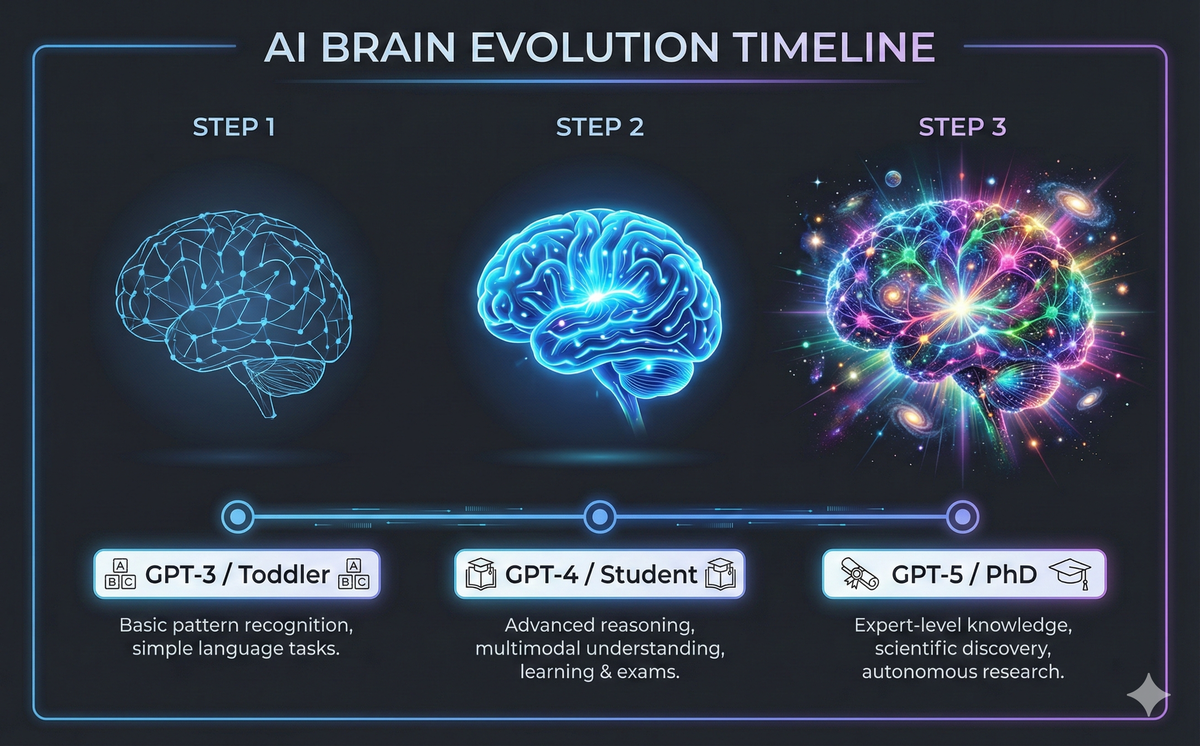
Why is GPT-5.2 better than GPT-4?
Think of the number as the Generation.
- GPT-3 (2020) was a toddler. It could talk, but it made no sense.
- GPT-4 (2023) was a high school student. Smart, but hallucinated mostly facts.
- GPT-5 (2025/2026) is a PhD working at a consulting firm.
The Rule of Thumb:
- A Full Number Jump (e.g., 4 to 5) is a "Brain Transplant." The model is fundamentally smarter.
- A Point Release await (e.g., 3.5 to 3.7) is usually a "Tune-up." It’s faster, cheaper, or slightly more accurate, but not a genius-level leap.
3. The Specs (Jargon Decoder)
When you look at the technical page, you see weird words. Here is what they actually mean in plain English.
Parameters
- What it says: "1.8 Trillion Parameters"
- What it means: Brain Cells.
- Roughly speaking, the more parameters, the more "knowledge" the model holds and the more nuance it understands. But more brain cells require more energy, which makes the model slower and more expensive.
Context Window (Tokens)
- What it says: "128k Context Window"
- What it means: Attention Span.
- A "Token" is roughly 3/4 of a word. A 128k window means the AI can remember about 300 pages of text in the current conversation. If you go over that limit, it forgets the beginning of the chat (like pushing old data off a cliff).
- Note: Gemini 3 Pro currently holds the record with a functionally infinite window (millions of tokens), meaning you can upload entire video libraries.
Multimodal
- What it says: "Native Multimodal Capabilities"
- What it means: Eyes and Ears.
- Old models only read text. Multimodal models can "see" images, "hear" audio files, and watch videos. You can show them a picture of your broken sink and ask, "How do I fix this?"
Conclusion
Don't let the marketing team confuse you.
- Check the Version Number (Higher is newer).
- Check the Trim Level (Pro/Sonnet is usually the safe bet).
- Check the Context Window (Do you need to upload a book?).
And remember: You don't need a Ferrari to drive to the grocery store. Start with the Standard model. Only upgrade to the Luxury model when you are stuck.
Don't just read about it. Try it.
You understand the concept. Now see how it works in the real world with this step-by-step guide.
Meet the Players
Want to keep learning?
Get our free AI Starter Kit — 5 lessons delivered to your inbox.
Join readers learning AI in plain English. No spam, ever.