The Professional Guesser
It feels like magic, but it's just math. Why AI isn't 'thinking' about your question—it's just betting on which word comes next.
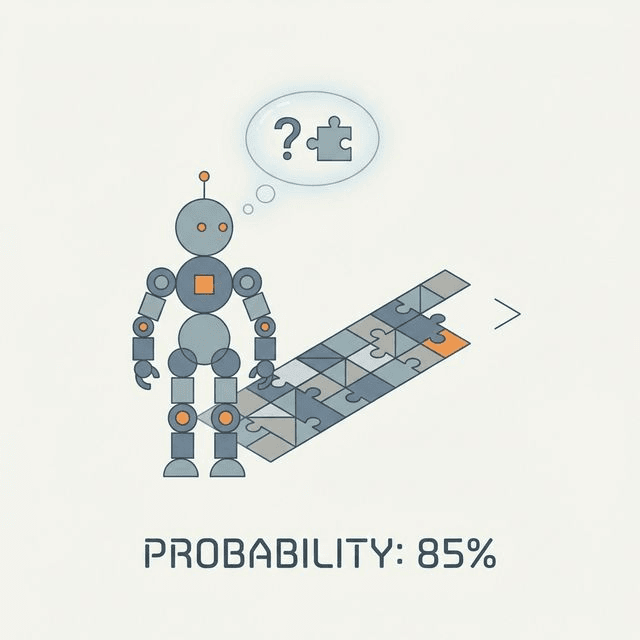
The Professional Guesser
Have you ever been texting a friend, typed "I'm on my," and watched your phone suggest "way"?
That is Artificial Intelligence.
It’s not conscious. It doesn't know where you are. It doesn't even know what a "way" is. It just knows that, statistically, when humans type "on my," the next word is usually "way."
Now, take that simple predictive text feature, feed it the entire internet, give it a billion dollars worth of supercomputers, and you get ChatGPT.
It is, at its core, a Professional Guesser.
The Probability Game
This is the most important mental model to hold onto: AI is playing a probability game, not a truth game.
When you ask it a question, it doesn't go to a library, find a book, and read you the answer. It looks at your question and calculates:
"Based on all the text I have ever seen in human history, what is the most likely cluster of words to follow this question?"
It predicts the first word. Then it uses that first word to predict the second. Then the third. It does this thousands of times per second.
Why "Hallucinations" Happen
You've probably heard that AI "hallucinates"—it makes things up.
If you understand the Professional Guesser model, this makes perfect sense. If I ask it, "Who was the first person to walk on Mars?" it might panic.
It knows "walk on" is usually followed by "the Moon" and "Neil Armstrong." The probability pull is so strong that it might just say "Neil Armstrong," even though that's factually wrong.
It's not lying to you. It's just taking a bad bet.
Why This is Useful
If it's just guessing, why use it?
Because it's a really good guesser. It has read more than you ever could. It has seen every contract, every email template, every Python script, and every recipe ever published.
- It guesses really well at structure. (e.g., "Write this as a professional email.")
- It guesses really well at tone. (e.g., "Sound like a pirate.")
- It guesses really well at summary. (e.g., "What are the main points of this text?")
The Fix: "Truth Serum" Prompts
You can't stop the guessing, but you can make the AI a better guesser.
When you need facts, don't just ask the question. Force the AI to show its work.
Add these phrases to your prompts:
- "Quote the text:" "Answer this question using ONLY the text I pasted below. Do not add outside information."
- "Citations please:" "List the specific sources or URL links for each claim."
- "Confidence check:" "If you do not know the answer for sure, say 'I don't know.' do not guess."
The Takeaway
Stop treating AI like an oracle that knows the truth. Treat it like a super-fast, well-read assistant who is aggressively trying to please you.
Trust its form (the writing style, the code structure). But always check its facts.
Don't just read about it. Try it.
You understand the concept. Now see how it works in the real world with this step-by-step guide.
Use the 90% Rule
Want to keep learning?
Get our free AI Starter Kit — 5 lessons delivered to your inbox.
Join readers learning AI in plain English. No spam, ever.