The 90% Rule
AI is not an autopilot; it's a co-pilot. Why it gets you almost there, and why the last 10% is the only thing that matters.
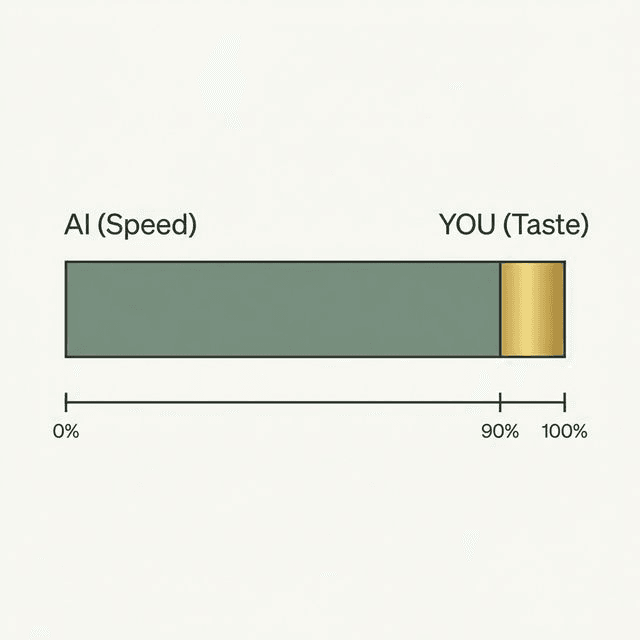
The 90% Rule
There is a dangerous fantasy that sells AI tools. It goes like this:
- You click a button.
- The AI does the work.
- You go to the beach.
This is the "Autopilot" mindset. And if you try to use AI this way in 2026, you will likely fail. You will produce generic, hallucinated, lifeless garbage.
Reason is simple: AI is not an Autopilot. It is an Engine.
And an engine needs a driver.
The Ratio
Successful AI users live by the 90% Rule.
It states that for any given task, AI can get you 90% of the way there in seconds. But it cannot do the last 10%.
And unfortunately, the last 10% is what makes the work actually good.
The 90% (What AI Does)
- Structure: It can outline a report instantly.
- Volume: It can write 50 email variations in a minute.
- Drafting: It can turn bullet points into paragraphs.
- Summary: It can crash-read a 50-page PDF.
The 10% (What YOU Do)
- Context: "Does this tone sound like us?"
- Fact-Checking: "Did it just invent a law?"
- Taste: "Is this actually interesting, or just grammatically correct?"
- Strategy: "Does this help our goal?"
Should I Use AI for This Task?
Here's the practical breakdown:
| Task | Use AI? | Why |
|---|---|---|
| Write a first draft (email, blog post, report) | ✅ Yes | AI excels at structure and volume. You edit for voice and accuracy. |
| Summarize a long document | ✅ Yes | AI can crash-read 50 pages in seconds. You verify key points. |
| Brainstorm ideas | ✅ Yes | AI generates 20 options fast. You pick the best one. |
| Final polish on important work | ❌ No | AI can't judge "good" vs. "great." That's your job. |
| Fact-checking critical information | ❌ No | AI hallucinates. Always verify facts yourself. |
| Personal, emotional writing | ❌ No | AI can't capture your unique voice or lived experience. |
| Quick, simple tasks (2-minute email) | ❌ No | Faster to just do it yourself than to prompt AI. |
The Rule: Use AI for the heavy lifting (structure, volume, speed). Reserve your energy for the final 10% (judgment, taste, truth).
The "Editor-in-Chief" Mindset
This changes your job description. You are no longer just the creator; you are the Editor-in-Chief.
Think about a newspaper editor. They don't write every word. They assign stories to reporters (the AI), and then they turn that raw copy into something great.
Here is how you actually do that 10% work.
The 3-Step "Human Polish" Checklist
Whenever you get a draft from AI, run it through this quick filter before you use it:
1. The "Vibe Check" (Tone) AI tends to sound like a corporate HR department—polite, wordy, and safe.
- Action: Cut the first paragraph (it's usually fluff).
- Action: Replace words like "delve," "leverage," and "ensure" with normal words like "dig," "use," and "make sure."
2. The "Fact Check" (Truth) AI is a smooth talker, which makes it hard to spot lies.
- Action: Verify every specific number, date, or law citation.
- Action: If it recommends a specific brand or product, Google it to make sure it actually exists.
3. The "Spike" (Insight) This is the most important one. Add one thing that only you know.
- Action: Inject a personal anecdote ("I tried this last year and...").
- Action: Add a specific constraint ("This works best if your budget is under $500").
- Action: Add a strong opinion. AI tries to be neutral; humans have opinions.
"Good Enough" is the Enemy
The trap of AI is that the output looks polished instantly. The grammar is perfect. The formatting is clean. It looks finished.
But if you copy-paste raw AI output, people can tell. It feels "smooth but empty."
By spending just 2 minutes applying the Human Polish, you turn "Robot Text" into "Augmented Human Work." You get the speed of the machine, but the soul of the human.
The Takeaway
Stop trying to get AI to do 100% of the work. It can't. Aim for 90%. Let it do the heavy lifting, the boring structuring, the first drafts.
Then, spend your energy on that final, critical 10%. That is where your value is.
Don't just read about it. Try it.
You understand the concept. Now see how it works in the real world with this step-by-step guide.
Draft Content in Minutes
Want to keep learning?
Get our free AI Starter Kit — 5 lessons delivered to your inbox.
Join readers learning AI in plain English. No spam, ever.